Door supervisors and security staff
SIA Security Officer Question Bank (Scotland)
Price: £19
One-off purchase. Instant download. UK buyers only, for now.
Secure checkout by Stripe. You confirm at checkout that you want the download straight away.
Faulty file? We fix it, replace it or refund you. Terms of sale and refunds.
- Two A4 PDFs (question bank, and answers and notes) and one self-marking HTML file that opens in any modern web browser and works offline
- Version 1.0.0, free updates to that version
- Every source linked, last checked 9 November 2026
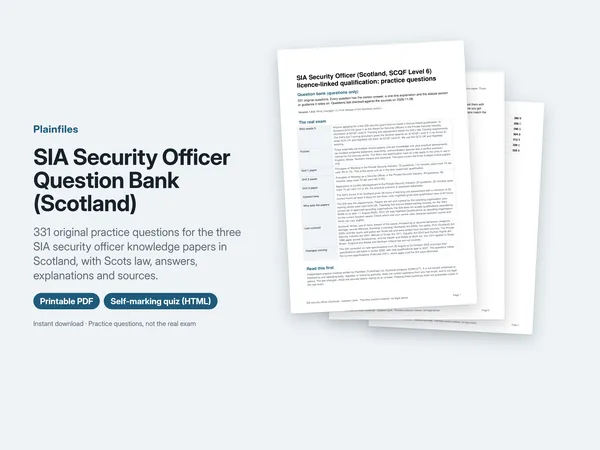
331 original practice questions for the three SIA security officer knowledge papers in Scotland (SCQF Level 6), with Scots law where it differs, each with the answer, an explanation and the source it relies on.
This is the Scotland version, for anyone preparing for the knowledge papers of the Award for Security Officers in the Private Security Industry (Scotland) at SCQF Level 6, the licence-linked qualification needed to apply for a first SIA security guard licence in Scotland. It has 331 original multiple-choice questions, written by Plainfiles from the SIA’s published test specification and knowledge requirements, the legislation and Scottish court and government sources: 290 questions that apply across the UK, checked so that none rests on the law of England and Wales, and 41 new questions on Scots law. Three of them, on citizen’s arrest, rest on Citizens Advice Scotland because no better free source was found, and are marked as good-practice questions.
The SIA’s Get Training document sets three multiple-choice papers: Unit 1 with 72 questions in 110 minutes (pass mark 70 per cent), Unit 2 with 60 questions in 90 minutes (70 per cent) and Unit 3 with 20 questions in 30 minutes (70 per cent). The awarding organisation your training centre uses sets and marks the real papers, and counts and times can vary slightly between them, so check with your centre. The self-marking quiz draws a timed mock paper for each unit. The practical assessments are marked by your training centre and are not covered.
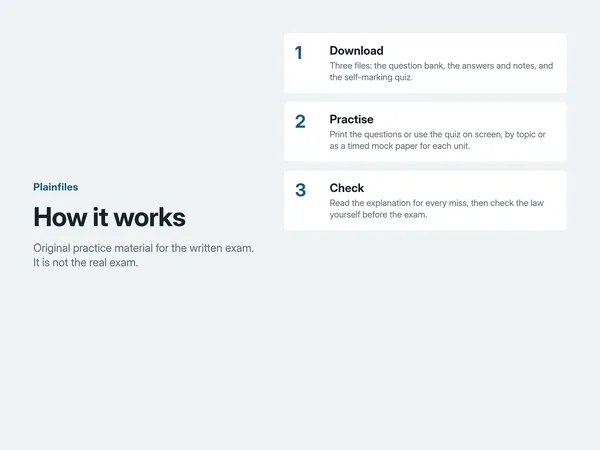
Formats: Two A4 PDFs (question bank, and answers and notes) and one self-marking HTML file that opens in any modern web browser and works offline.
Version 1.0.0, checked 9 November 2026. Updates to this version are free.
What is inside
Who makes this, and how it is checked
- Made by
- Plainfiles, run by TurboKast Ltd (company number SC881077), registered in Scotland. 29 Commercial Street, Dundee, DD1 3DG.
- Checked
- Against 45 official sources on 9 November 2026. Every source is linked below.
- Reviewed
- The free guide for this kit was reviewed by Liam Humphreys on .
- If a file is faulty
- We fix it, replace it or refund you. Terms of sale and refunds.
- Who can buy
- Buyers in the UK only, for now. Payment is handled by Stripe; you download the files straight after paying.
Written and designed by Plainfiles with the help of artificial intelligence (AI) tools, then checked against the official legislation and guidance listed in the sources. How we write and check our work.
What is included
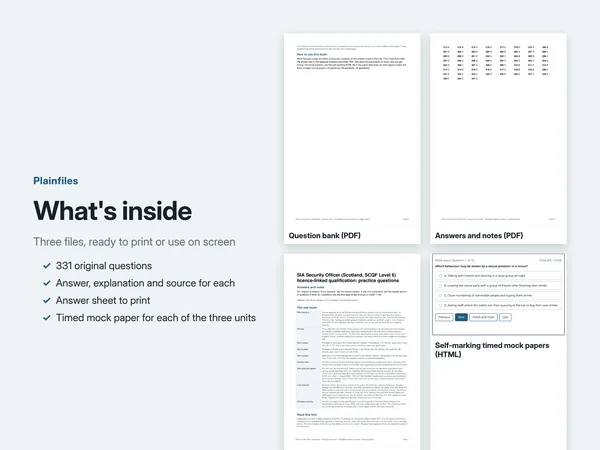
- Question bank (PDF, 48 pages)All 331 questions grouped by the topics of the three units, with a summary of the exam papers and an answer sheet to print.
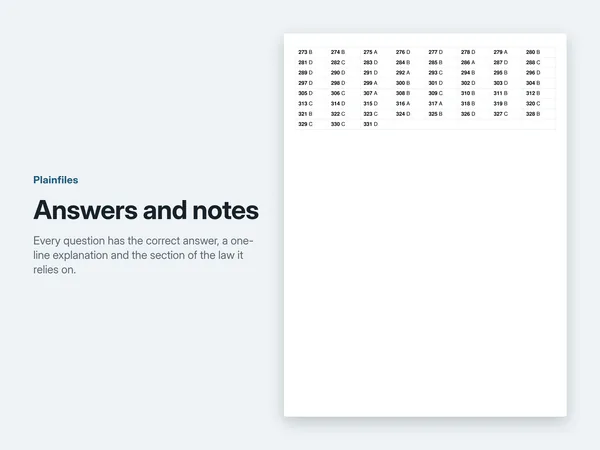
- Answers and notes (PDF, 49 pages)An answer key, then the correct answer to every question with a one-line explanation and the statute section or guidance it relies on.
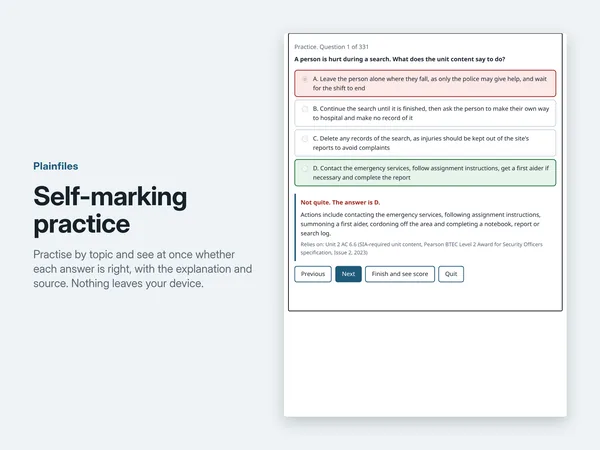
- Self-marking quiz (HTML file)A timed mock paper for each unit (72, 60 and 20 questions, with the time allowed and the pass mark for that unit), marked at the end, and practice by topic that shows the answer, explanation and source straight away.
What it is not
- These are original practice questions, not the real exam. The real papers are set by an awarding organisation and will word their questions differently, and passing these questions does not guarantee a pass.
- The questions are not from the SIA or any awarding body. The pack is not issued, endorsed or checked by the SIA, an awarding body or a training centre, and it contains no questions from any real paper or sample paper.
- It is the Scotland version. It does not cover the law of England and Wales, and it has not been checked by a Scottish solicitor. If you are training in England or Wales, you need the England and Wales question bank instead.
- It is not legal advice. The law changes, so check the sources before you rely on an answer.
- It does not book your training or the exam, and it does not apply for your licence. You take the course and the assessments with a training centre, and you apply to the SIA yourself.

Five sample questions from the bank
Copied word for word from the 331 questions in the kit. None of them is one of the 25 free ones. Pick an answer, then open it to see the explanation and the source.
Sample question 1
Unit 1, topic 3: Arrest and use of force
Why should an arrest by a security operative be a last resort?
Show the answer
Answer D. Taking someone’s liberty is serious, a false arrest can lead to legal action, and the security operative’s own safety may be at risk
Other options, such as de-escalation, refusing entry, ejection or calling the police, are often safer and lower risk. Arrest carries legal risk and physical danger.
Relies on: Unit 1 AC 3.5 (SIA-required unit content, Pearson BTEC specification, Issue 2, 2023).
Sample question 2
Unit 1, topic 7: Communication
Why is effective communication important in security work?
Show the answer
Answer B. It makes sure the message is received and understood, which helps teamwork and prevents misunderstandings that could lead to aggression
Clear communication prevents misinterpretation and mistakes, promotes teamwork and a professional service, and can stop a situation turning aggressive.
Relies on: Unit 1 AC 7.2 (SIA-required unit content, Pearson BTEC specification, Issue 2, 2023).
Sample question 3
Unit 1, topic 11: Post-incident management
What is a benefit of reflecting on incidents?
Show the answer
Answer A. Areas for improvement and good practice can be identified and shared
Reflection lets organisations spot trends, improve procedures, recognise good and poor practice and prevent a repeat.
Relies on: Unit 1 AC 11.3 (SIA-required unit content, Pearson BTEC specification, Issue 2, 2023).
Sample question 4
Unit 2, topic 4: Minimising risk to personal safety at work
What is a personal safety benefit of dynamic risk assessment?
Show the answer
Answer D. It helps the officer to analyse the risk and the best course of action before, during and after an incident
Dynamic risk assessment ensures a process of analysing risk and choosing the best action throughout, and it improves the ability to react to changing situations.
Relies on: Unit 2 AC 4.4 (SIA-required unit content, Pearson BTEC Level 2 Award for Security Officers specification, Issue 2, 2023).
Sample question 5
Unit 3, topic 1: Principles of conflict management
How can a security operative reduce the chance of conflict at the entrance?
Show the answer
Answer D. Explain rules and decisions clearly and politely before problems build up
Clear, polite explanations manage expectations and prevent misunderstandings, which are among the most common causes of conflict.
Relies on: Unit 3 AC 1.1 and AC 1.2 (SIA-required unit content, Pearson BTEC specification, Issue 2, 2023).
What £19 adds to the free quiz
The free 25-question quiz is free to use and stays free. The kit gives you:
- All 331 questions, not 25, grouped by topic.
- Printable PDFs: the question bank, and an answers and notes book that explains every answer and gives its source.
- A self-marking file with timed mock papers and practice by topic, which opens in any browser and works offline.
Sources and checking
Checked against these official sources on 9 November 2026:
- SIA, Get Training: requirements for awarding organisations and training centres delivering SIA licence to practise qualifications (first published Feb 2021, updated Apr 2022): test specification for each unit; section ‘Delivery of content specific to the devolved nations’; Annex B (Scotland)
- GOV.UK, Check what training you need to get an SIA licence (updated 20 Aug 2026): current Scottish qualification titles and awarding organisation
- GOV.UK, Teaching SIA licence-linked training courses (updated 20 Aug 2026): SIA-approved awarding organisations; BIIAB qualifications not accepted if issued on or after 11 Aug 2026
- SQA Accreditation (now Qualifications Scotland Accreditation), ACG decision list 31 March 2021: Scottish SCQF Level 6 door supervisor, security officer and CCTV awards
- Private Security Industry Act 2001, section 3 (extends to England, Wales and Scotland)
- Criminal Procedure (Scotland) Act 1995, section 225 (standard scale: level 1 £200, level 3 £1,000, level 5 £5,000; prescribed sum £10,000)
- Police and Criminal Evidence Act 1984, section 24A (extent: England and Wales only)
- Criminal Justice (Scotland) Act 2016, sections 1 and 45 (arrest and reasonable force by a constable)
- Criminal Justice and Licensing (Scotland) Act 2010, section 38 (threatening or abusive behaviour)
- Criminal Law (Consolidation) (Scotland) Act 1995, sections 47, 49 and 52 (offensive weapons, bladed articles, vandalism)
- Sexual Offences (Scotland) Act 2009, sections 1, 3 and 9 (rape, sexual assault, voyeurism)
- Police and Fire Reform (Scotland) Act 2012, sections 1, 6 and 20
- Fire (Scotland) Act 2005, sections 53, 54, 56, 61 and 72
- Fire Safety (Scotland) Regulations 2006 (SSI 2006/456), regulations 14 and 20
- McGrow v HM Advocate [2026] HCJAC 13 (self-defence in Scots law), Scottish Courts and Tribunals Service
- Harris v HM Advocate [2009] HCJAC 80 (breach of the peace; five-judge court applying Smith v Donnelly), Scottish Courts and Tribunals Service
- Crown Office and Procurator Fiscal Service (COPFS), Our role in the justice process
- COPFS, About COPFS (death investigation)
- COPFS, Words and meanings (updated 17 Mar 2026): corroboration, precognition, citation, solemn case, justice of the peace
- COPFS, Sexual offences (updated 5 Oct 2026): consent
- Police Scotland, Contact us: report a crime (999 and 101)
- Citizens Advice Scotland, If you are arrested and held in custody by the police in Scotland (citizen’s arrest)
- Scottish Government, Scottish Crime Recording Standard: Crime Recording and Counting Rules (Group 1: assault, common law)
- Sheku Bayoh Public Inquiry, Law and Practice Research Note (11 May 2022): malicious mischief
- Misuse of Drugs Act 1971 (applies UK-wide)
- Health and Safety at Work etc. Act 1974 (applies in Great Britain)
- Equality Act 2010
- Human Rights Act 1998, Schedule 1
- Reporting of Injuries, Diseases and Dangerous Occurrences Regulations 2013
- GOV.UK, Penalties for drug possession and dealing
- GOV.UK, Terrorism and national emergencies: threat levels
- GOV.UK, Fire safety risk assessment: small and medium places of assembly (used only for the fire triangle)
- HSE, Managing risks and risk assessment at work; Protecting lone workers (INDG73)
- ProtectUK, HOT protocol
- SIA, Knowledge and Skills Specification: Common security industry knowledge (Feb 2021)
- SIA, Knowledge and Skills Specification: Conflict Management (Feb 2021)
- GOV.UK, SIA consults on changes to security licence qualifications (28 Aug 2026): consultation closed 23 Oct 2026, new qualifications planned for later in 2027
- Highfield Qualifications, Award for Security Officers in the Private Security Industry (Scotland) at SCQF Level 6: product page (total qualification time 42; specification not publicly available)
- SIA, Knowledge and Skills Specification: Security Guarding (Feb 2021)
- Pearson BTEC Level 2 Award for Security Officers in the Private Security Industry, specification Issue 2 (Sept 2023): numbering of the Unit 2 assessment criteria used to organise topics (England and Wales version; the Scots-law questions are not taken from it, but the UK-wide practice questions follow its unit content)
- Personal Protective Equipment at Work Regulations 1992
- UK General Data Protection Regulation, Article 5; Data Protection Act 2018
- ICO, Body worn video (BWV) guidance
- GOV.UK, Find out if you need an SIA licence (last updated 29 Jan 2026)
- Licensing (Scotland) Act 2005, sections 1, 4, 14, 15, 19, 94 to 97, 102 to 106, 111 to 116, 122, 138, 147 and Schedule 3 paragraphs 4, 9A and 11
Written and designed by Plainfiles with the help of artificial intelligence (AI) tools, then checked against the official legislation and guidance listed in the sources. These kits are independent templates to help you organise your paperwork. They are not legal, tax or financial advice, are not issued or endorsed by any government body, regulator or council, and do not guarantee a licence, rating or any other outcome.
Free guides that go with this kit
- SIA security officer practice test for Scotland: 25 free questions Exam practice
- SIA door supervisor practice quiz for Scotland: 25 free questions Exam practice
- SIA security officer practice questions: 25 free exam questions with answers Exam practice
- How to get an SIA licence: cost, training and how long it takes SIA licensing
Get the SIA Security Officer Question Bank (Scotland)
Price: £19
One-off purchase. Instant download. UK buyers only, for now.
Secure checkout by Stripe. You confirm at checkout that you want the download straight away.
Faulty file? We fix it, replace it or refund you. Terms of sale and refunds.
Training in England or Wales? See the England and Wales security officer question bank.