Contents
Status at 26 October 2026: in-house CCTV staff are not licensed, but this is under review
Today, staff who watch CCTV as direct employees of the organisation that uses it do not usually need an SIA licence. The Home Office consulted from 18 December 2025 to 12 March 2026 on licensing in-house CCTV operators. We found no published response, and no change has taken effect.
Great Britain only, and not legal advice
This guide covers England, Wales and Scotland, not Northern Ireland. Data protection law applies to anyone running CCTV and is not covered here. The SIA can confirm your own case.
The short version
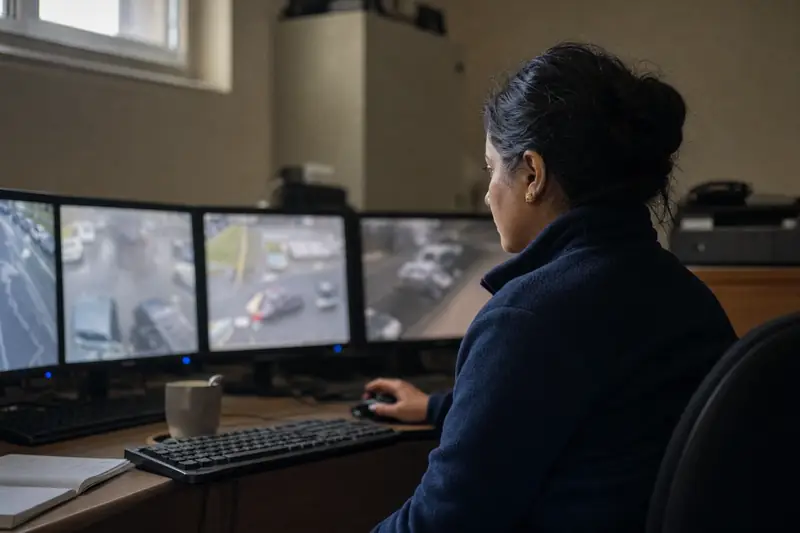
- You need a public space surveillance (CCTV) licence if you work under a “contract for services” and use CCTV to identify people or monitor their activities to guard premises against disorder or damage, or to guard people against injury or assault. GOV.UK says this includes viewing recorded footage.
- In-house staff usually do not need one. In-house means you are employed directly by the organisation that uses your services.
- Working without a licence when you need one is an offence under section 3 of the Private Security Industry Act 2001. The maximum is 6 months in prison, a level 5 fine, or both.
- The in-house exemption is under review, but nothing has changed yet.
What the law says
Section 3 of the Act makes it an offence to carry out “licensable conduct” without a licence. Almost every route into licensable conduct in section 3(2) depends on a contract for the supply of services. The exceptions in section 3(2)(g) to (i) cover “activities subject to additional controls”, meaning door supervision at licensed premises. The Act says that control does not apply to activities which only involve CCTV equipment (Schedule 2, paragraph 8(1C)(a)).
The activity itself is “manned guarding”, which includes carrying out “any form of patrol or surveillance” to deter something happening or to provide information about it afterwards (Schedule 2, paragraph 2(3)). Orders for England and Wales (2006) and for Scotland (2007) designate manned guarding as licensable. The SIA’s CCTV licence is its label for part of that activity.
What the SIA says
GOV.UK’s “Find out if you need an SIA licence” (updated 29 January 2026) gives the working definitions:
- A contract for services is when you or your employer have a contract to supply your services to another organisation. GOV.UK’s examples are a security company placing you as a guard at a client’s shop, and a self-employed person whose business is contracted to provide a service.
- In-house means you are employed directly by the company that uses your services. You do not usually need a licence, unless the job is door supervision at licensed premises (or vehicle immobilising in Northern Ireland).
- A CCTV licence is for using closed circuit video surveillance to identify people or monitor their activities to guard premises against disorder or damage, or to guard people against being injured or assaulted because of others’ unlawful conduct. That includes stopping those things and providing information if they happen, “including by viewing recorded footage”.
The licence is named “public space surveillance”, but the SIA’s description is about purpose, not where the camera is. We found no location test.
Common situations
| Situation | Licence needed? | Basis |
|---|---|---|
| A security company’s operator watches a live feed for a client to prevent disorder or damage | Yes, CCTV licence | Contract for services |
| A shop employs its own staff to watch its cameras | Not usually | In-house |
| A self-employed person is paid by a business to monitor its cameras | Yes, if the purposes above apply | Contract for services (GOV.UK’s examples include a self-employed business contracted to provide a service) |
| Contracted staff review recorded footage after an incident to find out what happened | Yes, for the purposes above | GOV.UK: includes viewing recorded footage |
| Contracted staff use cameras only to guard premises against unauthorised access or property against damage or theft | A security guard licence covers this, and so does the CCTV licence | GOV.UK |
| Contracted staff watch bodycam or headcam footage | Yes, as for other CCTV | GOV.UK bodycam guidance (4 November 2024) |
| An unpaid volunteer | No, if there is an agreement that no payment or reward is given | GOV.UK |
On 29 January 2026 the SIA changed its guidance. A security guard licence was described as not allowing recorded CCTV footage at all. It now says a guard licence does not cover CCTV used against disorder, damage, injury or assault, including viewing recorded footage. That needs the CCTV licence.
Employees watching their own employer’s premises
GOV.UK’s guidance for shopping centres and retail outlets says staff you employ directly, who are not contracted out to anyone else, will not usually need a licence. The position changes if your employer supplies your services to another organisation. GOV.UK’s own example is a shopping centre operator that employs a guard and charges the shops a fee for that person’s services, which is a contract for services. If you manage or supervise licensable staff in a business that supplies security under contracts, GOV.UK says you need a licence too, front line or non-front line.
A business that supplies unlicensed operatives under contract can also commit an offence under section 5 of the Act, with defences if it did not know and had no reason to suspect, or took all reasonable steps.
What may change: the Manchester Arena Inquiry
The Inquiry’s Volume 1 report (June 2021) made monitored recommendation 7 (MR7): “The requirement that only those monitoring CCTV under a contract for services need to hold an SIA licence should be reviewed.” The Home Office’s consultation document explains why: of two CCTV operators at the Arena, one was a contractor who needed a licence and the other was in-house and exempt.
The Home Office consulted from 18 December 2025 to 12 March 2026. Its options ran from doing nothing to licensing several in-house roles, and it said it had no preferred option. It promised a summary of responses within 12 weeks of the close, which is 4 June 2026. As of 26 October 2026 the consultation page shows no response. On 30 September 2026 the Security Minister said the government “remains committed” to recommendations 7 and 8 and “is reviewing consultation responses, with a formal response to be published as soon as possible”.
The SIA’s strategic plan for 2026 to 2029 (first published 8 June 2026) refers to the possible removal of in-house licensing exemptions “if approved by Government and Parliament”. Its business plan for 2026 to 2027 (7 July 2026) says it will work with the Home Office on a roadmap for “the preferred in-house licensing options”, “subject to Ministerial agreement on this proceeding and which option they select”. We found no start date or decision. Until there is one, the rules above apply.
One label can mislead. The government’s Manchester Arena Inquiry recommendations dashboard (October 2026 snapshot, published 5 October 2026, “no new update received”) lists MR7 as “Accepted in full” with delivery status “Completed”. Its progress note says Home Office Ministers “committed to reviewing” MR7 and MR8 and “This is now complete”. We read that as the commitment to review, not a change to the rules, because the consultation response is unpublished and the Minister said on 30 September 2026 that responses were still being reviewed. The same wording appears in the February and May 2026 snapshots.
If you do need a licence
You need a current licence-linked qualification first: in England and Wales the Level 2 Award for Working as a CCTV Operator (Public Space Surveillance) within the Private Security Industry, and in Scotland an equivalent award at SCQF level 6. GOV.UK gives the application fee as £204 for one licence (from 1 April 2026) and says licences last 3 years. Our SIA licence guide covers the steps. Our free CCTV operator practice test has 25 original questions, and the paid CCTV operator question bank has 256 for £19. They are for the course exams, not from the SIA or an awarding body.
Frequently asked questions
Do I need an SIA licence to watch my own business’s CCTV?
Not usually. If you or your own employees watch your cameras, you are working in-house. The SIA says in-house staff do not usually need a licence.
Does viewing recorded footage need a licence?
If you are working under a contract for services and the purposes above apply, yes. GOV.UK says the CCTV licence covers viewing recorded footage.
Is in-house CCTV licensing going to be introduced?
It is being considered. The Home Office consulted until 12 March 2026 and, as of 26 October 2026, has not published its response. Nothing is in force.
Does the rule cover cameras at home?
The SIA’s tests concern work under a contract for services. We found no SIA guidance on home cameras.
What we could not confirm
We could not confirm any government decision beyond the minister’s statement of 30 September 2026, and we did not check how the Inquiry itself regards MR7. We did not check how CCTV installers or alarm monitoring centres are treated.
Sources
Last checked 26 October 2026. Dates in brackets are when each page says it was last updated.
- Find out if you need an SIA licence, SIA on GOV.UK (29 January 2026)
- Check if you need a licence at shopping centres or retail outlets, SIA on GOV.UK (16 June 2025)
- Check if you need an SIA licence to use a bodycam, SIA on GOV.UK (4 November 2024)
- Private Security Industry Act 2001, sections 3 and 5 and Schedule 2, legislation.gov.uk (current version, checked 26 October 2026; shown as up to date to 25 October 2026 for sections 3 and 5 and 26 October 2026 for Schedule 2)
- Designated Activities Order 2006 and Designated Activities (Scotland) Order 2007, legislation.gov.uk
- Licensing of contractors who carry out security services and in-house CCTV operators, Home Office (18 December 2025), with its consultation document
- SIA update to the Manchester Arena Inquiry, January 2023, SIA (3 March 2023): the wording of MR7
- Security Minister’s speech at the International Security Expo, Home Office (30 September 2026)
- SIA strategic plan: 2026 to 2029, SIA (23 June 2026)
- SIA business plan: 2026 to 2027, SIA (7 July 2026)
- Manchester Arena Inquiry recommendations, Cabinet Office on GOV.UK (13 October 2026), and its October 2026 data page
- Apply for an SIA licence, SIA on GOV.UK (19 June 2026)
- Check what training you need to get an SIA licence, SIA on GOV.UK (20 August 2026)
Changes to this guide
- 26 October 2026: Draft written and checked against the legislation and the GOV.UK pages.
This guide is general information written from the official sources listed above and checked on 26 October 2026. It is not legal, tax or financial advice, and Plainfiles is not endorsed by any government body. Rules change, so check the linked official pages for your own situation. Written and designed by Plainfiles with the help of artificial intelligence (AI) tools, then checked against the official legislation and guidance listed in the sources. How we write and check our guides.