Other exam practice
TfL SERU Practice Questions: London Private Hire Drivers
Price: £12
One-off purchase. Instant download. UK buyers only, for now.
Secure checkout by Stripe. You confirm at checkout that you want the download straight away.
Faulty file? We fix it, replace it or refund you. Terms of sale and refunds.
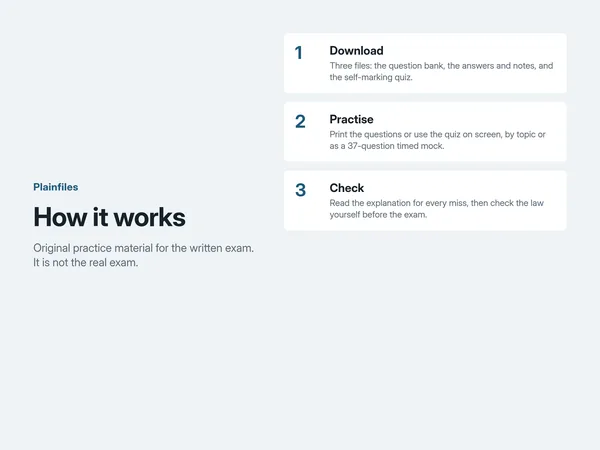
- Two A4 PDFs (question bank, and answers and notes) and one self-marking HTML file that opens in any modern web browser and works offline
- Version 1.0.0, free updates to that version
- Every source linked, last checked 9 November 2026
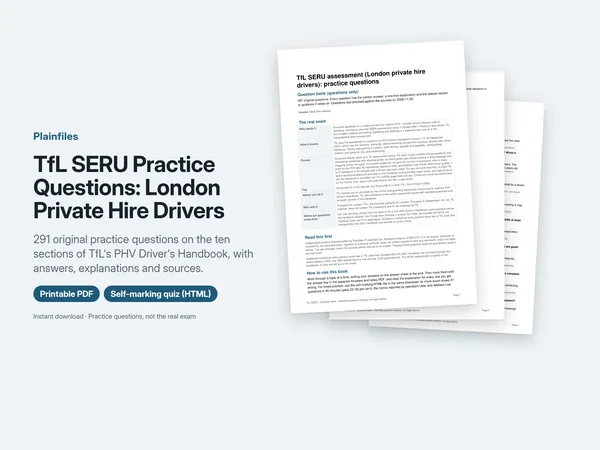
291 original practice questions on the ten sections of TfL’s PHV Driver’s Handbook, for London private hire (minicab) drivers preparing for the SERU assessment, each with the answer, an explanation and the handbook section or law it relies on.
This pack is for anyone applying for, or renewing, a London private hire vehicle (PHV, minicab) driver’s licence who has to pass TfL’s Safety, Equality and Regulatory Understanding (SERU) assessment. It has 291 original questions across the ten sections of TfL’s free PHV Driver’s Handbook (Version 1.0), which TfL says the assessment is based on: licensing, vehicle licensing, private hire journeys, staying safe, driver behaviour, driving and parking in London, safer driving, equality and disability, safeguarding, and ridesharing. Styles include multiple choice, complete the sentence and short reading passages, all in our own words. Each question names the handbook section or the law (the Private Hire Vehicles (London) Act 1998, the Equality Act 2010, the Highway Code) it relies on.
The test format is as reported by operators; check your booking confirmation. TfL’s public pages do not give the number of questions, the time or the pass mark for the PHV test. The self-marking mock uses 37 questions in 45 minutes with a pass mark of 23 (60 per cent), as reported by operators Uber and Addison Lee in their 2023 driver guides; TfL has not confirmed this. In 2024 TfL said it would trial letting drivers use the handbook during the test (open book), and TfL’s page does not say either way now. The handbook dates from 2021, so 14 extra-practice questions (outside the mock) cover rules that changed since, such as the 2022 Equality Act duties to disabled passengers and assistance dog users, the DBS Update Service and the London-wide ULEZ.
Formats: Two A4 PDFs (question bank, and answers and notes) and one self-marking HTML file that opens in any modern web browser and works offline.
Version 1.0.0, checked 9 November 2026. Updates to this version are free.
What is inside
Who makes this, and how it is checked
- Made by
- Plainfiles, run by TurboKast Ltd (company number SC881077), registered in Scotland. 29 Commercial Street, Dundee, DD1 3DG.
- Checked
- Against 17 official sources on 9 November 2026. Every source is linked below.
- Reviewed
- The free guide for this kit was reviewed by Liam Humphreys on .
- If a file is faulty
- We fix it, replace it or refund you. Terms of sale and refunds.
- Who can buy
- Buyers in the UK only, for now. Payment is handled by Stripe; you download the files straight after paying.
Written and designed by Plainfiles with the help of artificial intelligence (AI) tools, then checked against the official legislation and guidance listed in the sources. How we write and check our work.
What is included
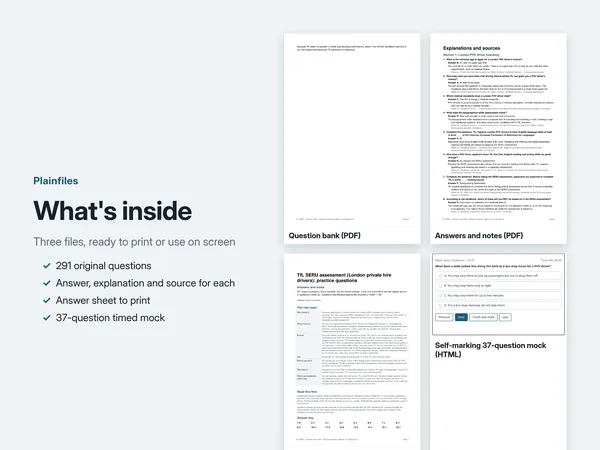
- Question bank (PDF, 39 pages)All 291 questions grouped by the ten handbook sections, with a summary of the assessment and an answer sheet to print.
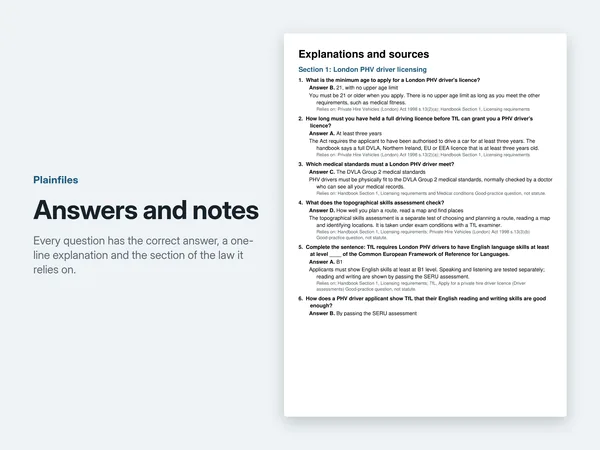
- Answers and notes (PDF, 37 pages)An answer key, then the correct answer to every question with a one-line explanation and the handbook section or law it relies on.
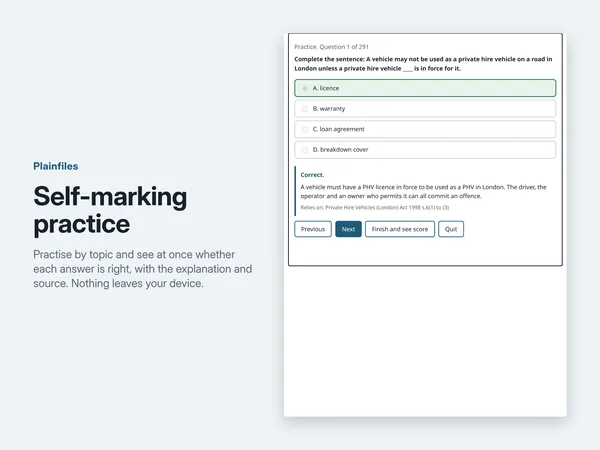
- Self-marking quiz (HTML file)A 37-question timed mock drawn from all ten sections, marked at the end against a pass mark of 23, and practice by section that shows the answer, explanation and source straight away.
What it is not
- These are original practice questions, not the real assessment. TfL has not endorsed or checked them, they are not TfL material, and they contain no questions from TfL’s online guide, any real test, past paper, app or course. Passing these questions does not guarantee a pass.
- TfL does not publish the number of questions, time or pass mark for the PHV SERU assessment. The mock follows what operators report; check your booking confirmation.
- It does not cover the English speaking and listening test or the topographical skills assessment, which are separate.
- It is not legal advice. The law and TfL’s rules change, so check the sources before you rely on an answer.
- It does not book your assessment or apply for your licence. You do that with TfL.

Five sample questions from the bank
Copied word for word from the 291 questions in the kit. None of them is one of the 25 free ones. Pick an answer, then open it to see the explanation and the source.
Sample question 1
Section 2: Licensing requirements for PHVs
In exceptional cases a PHV may be exempt from displaying licence discs. What must the driver do then?
Show the answer
Answer C. Carry the exemption notice whenever the vehicle is used as a PHV
If a vehicle has an exemption from displaying discs, the driver must carry the exemption notice at all times while the vehicle is being used as a PHV.
Relies on: Handbook Section 2, Licences and licence discs; Private Hire Vehicles (London) Act 1998 s.10(3).
Sample question 2
Section 4: Staying safe
You have called 999 for an injured passenger who is now being violent. What does the handbook advise while you wait?
Show the answer
Answer D. Move somewhere safe where you can still see them
Keep yourself safe first: stand somewhere out of reach but keep them in sight until help comes.
Relies on: Handbook Section 4, Drugs and alcohol.
Sample question 3
Section 6: Driving and parking in London
How can you identify a parking bay on a red route?
Show the answer
Answer B. By a “P” on the sign that goes with it
Parking bays on red routes have a “P” on their signs. The signs show when parking is allowed, for how long, and how soon you may return to the same section.
Relies on: Handbook Section 6, Red routes.
Sample question 4
Section 8: Being aware of equality and disability
TfL refuses your application for an exemption certificate. What can you do?
Show the answer
Answer A. Appeal to a magistrates’ court within 28 days
A person aggrieved by a refusal to issue an exemption certificate may appeal to a magistrates’ court within 28 days beginning with the date of the refusal.
Relies on: Equality Act 2010 s.172(1).
Sample question 5
Section 10: Ridesharing
What should you do as soon as you pick up each ridesharing passenger?
Show the answer
Answer D. Confirm that each one booked a rideshare
To reduce problems, check with every passenger, as soon as you collect them, that they meant to book a rideshare.
Relies on: Handbook Section 10, Ridesharing.
What £12 adds to the free quiz
The free 25-question quiz is free to use and stays free. The kit gives you:
- All 291 questions, not 25, grouped by topic.
- Printable PDFs: the question bank, and an answers and notes book that explains every answer and gives its source.
- A self-marking file with timed mock papers and practice by topic, which opens in any browser and works offline.
Sources and checking
Checked against these official sources on 9 November 2026:
- TfL, SERU for private hire drivers
- TfL, PHV Driver’s Handbook, Version 1.0 (30 September 2021), PDF
- TfL, Apply for a private hire driver licence
- TfL, Taxi and private hire licence fees, Notice 05/26 (PDF)
- TfL, OnRoute magazine, Spring 2024 (issue 33): SERU open-book trial (PDF)
- Uber, SERU assessment driver guide (February 2023)
- Addison Lee, What should I study for the TfL SERU test? (July 2023)
- TfL, SERU online assessment guide (learning material)
- Private Hire Vehicles (London) Act 1998
- Equality Act 2010, sections 4 and 164A to 172
- Criminal Justice and Public Order Act 1994, section 167 (touting)
- The Highway Code (GOV.UK)
- GOV.UK, Child car seats: the rules
- TfL, Discounts and exemptions for Congestion Charge
- TfL, Ultra Low Emission Zone discounts and exemptions
- Equality Act 2010, section 165A (assistance to identify and find the vehicle)
- Equality Act 2010, section 167A (duties of operators of private hire vehicles)
Written and designed by Plainfiles with the help of artificial intelligence (AI) tools, then checked against the official legislation and guidance listed in the sources. These kits are independent templates to help you organise your paperwork. They are not legal, tax or financial advice, are not issued or endorsed by any government body, regulator or council, and do not guarantee a licence, rating or any other outcome.
Free guides that go with this kit
Get the TfL SERU Practice Questions
Price: £12
One-off purchase. Instant download. UK buyers only, for now.
Secure checkout by Stripe. You confirm at checkout that you want the download straight away.
Faulty file? We fix it, replace it or refund you. Terms of sale and refunds.