Other exam practice
ADI Part 1 Practice Questions: Driving Instructor Theory Test
Price: £19
One-off purchase. Instant download. UK buyers only, for now.
Secure checkout by Stripe. You confirm at checkout that you want the download straight away.
Faulty file? We fix it, replace it or refund you. Terms of sale and refunds.
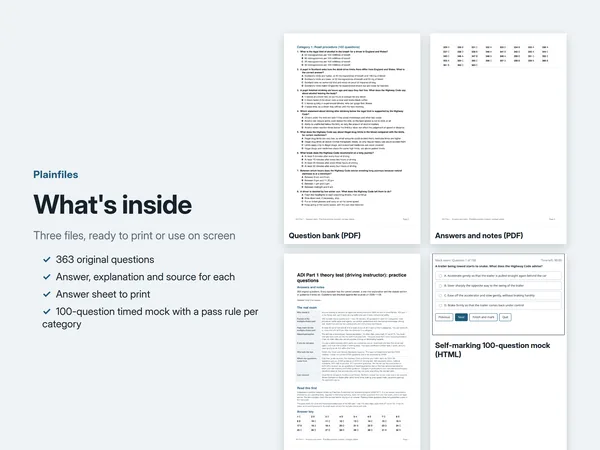
- Two A4 PDFs (question bank, and answers and notes) and one self-marking HTML file that opens in any modern web browser and works offline
- Version 1.0.0, free updates to that version
- Every source linked, last checked 9 November 2026
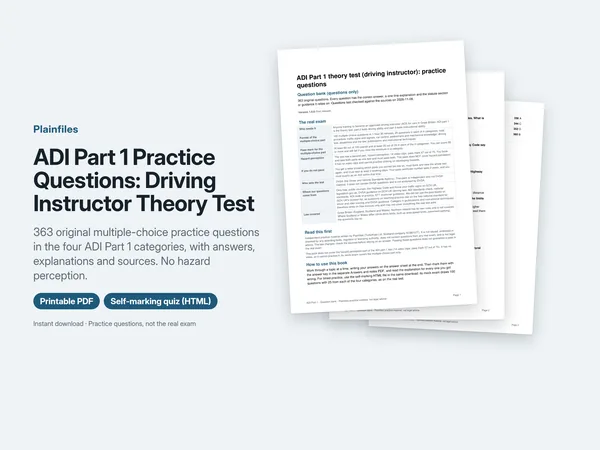
363 original multiple-choice practice questions in the four categories of the ADI Part 1 theory test (Great Britain), each with the answer, an explanation and the source it relies on. Hazard perception is not covered.
This pack is for anyone preparing for the multiple-choice part of the ADI Part 1 theory test, the first of the three tests to become an approved driving instructor for cars in Great Britain. It has 363 original multiple-choice questions in the four categories GOV.UK names: road procedure; traffic signs and signals, car control, pedestrians and mechanical knowledge; driving test, disabilities and the law; and publications and instructional techniques. They are written by Plainfiles only from free public sources: the Highway Code and Know your traffic signs, legislation.gov.uk and DVSA guidance on GOV.UK.
Hazard perception is not covered. The real test has a second part, 14 video clips with a pass mark of 57 out of 75, and you must pass both parts. This pack has no video and cannot practise it, so passing its mock is not the same as passing the test. The publications and instructional techniques category relies on free sources only. We did not use the paid books on GOV.UK’s revision list, so its questions on teaching practice rest on the free national standard for driver and rider training and DVSA guidance, and may not cover everything the real test asks. The real multiple-choice part is 100 questions in 1 hour 30 minutes, 25 in each category, and needs at least 85 out of 100 overall and at least 20 out of 25 in each category; the self-marking mock follows that rule. Twelve questions follow the current voluntary ADI code of practice and say so; DVSA has said a new mandatory code is expected from late 2026 to early 2027, so check GOV.UK before relying on them.
Formats: Two A4 PDFs (question bank, and answers and notes) and one self-marking HTML file that opens in any modern web browser and works offline.
Version 1.0.0, checked 9 November 2026. Updates to this version are free.
What is inside
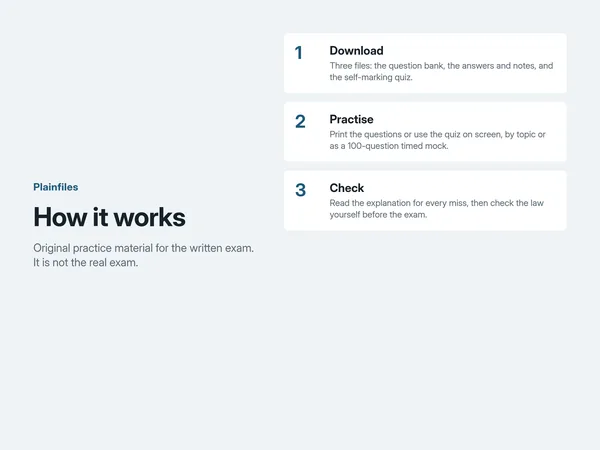
Who makes this, and how it is checked
- Made by
- Plainfiles, run by TurboKast Ltd (company number SC881077), registered in Scotland. 29 Commercial Street, Dundee, DD1 3DG.
- Checked
- Against 27 official sources on 9 November 2026. Every source is linked below.
- Reviewed
- The free guide for this kit was reviewed by Liam Humphreys on .
- If a file is faulty
- We fix it, replace it or refund you. Terms of sale and refunds.
- Who can buy
- Buyers in the UK only, for now. Payment is handled by Stripe; you download the files straight after paying.
Written and designed by Plainfiles with the help of artificial intelligence (AI) tools, then checked against the official legislation and guidance listed in the sources. How we write and check our work.
What is included
- Question bank (PDF, 47 pages)All 363 questions grouped by the four categories, with a summary of the test and an answer sheet to print.
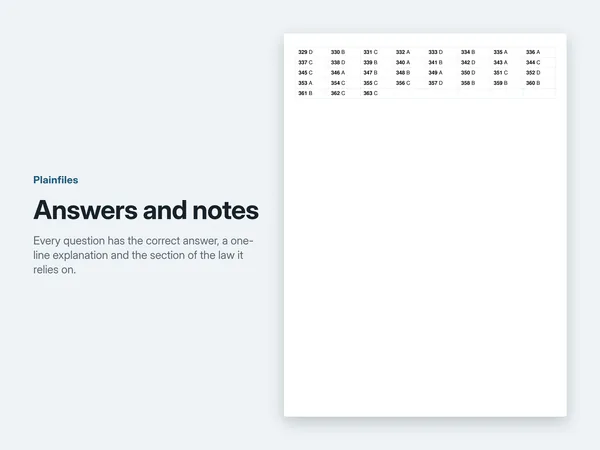
- Answers and notes (PDF, 48 pages)An answer key, then the correct answer to every question with a one-line explanation and the Highway Code rule, law or guidance it relies on.
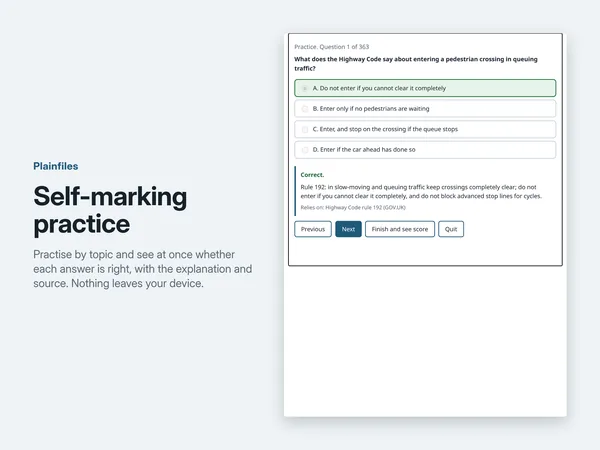
- Self-marking quiz (HTML file)A 100-question timed mock drawn 25 from each category, marked at the end against the 85 overall and 20 per category rule, and practice by topic that shows the answer, explanation and source straight away.
What it is not
- These are original practice questions, not the real test. DVSA has not endorsed or checked them, they are not DVSA material, and they contain no questions from any real test, past paper, book or app. Passing these questions does not guarantee a pass.
- It does not cover hazard perception, the video part of the ADI Part 1 test. You must practise that part some other way.
- Its publications and instructional techniques category is written only from free sources, so it may not cover everything the real test asks.
- It is not legal advice. The law changes, so check the sources before you rely on an answer.
- It does not book your test. You book the ADI Part 1 test yourself on GOV.UK.
Five sample questions from the bank
Copied word for word from the 363 questions in the kit. None of them is one of the 25 free ones. Pick an answer, then open it to see the explanation and the source.
Sample question 1
Category 1: Road procedure
What does the Highway Code advise about road position on right-hand bends?
Show the answer
Answer B. Keep well to the left, to improve your view and avoid oncoming traffic
Rule 160: keep well to the left on right-hand bends; this improves your view of the road and helps avoid colliding with traffic approaching from the opposite direction.
Relies on: Highway Code rule 160 (GOV.UK).
Sample question 2
Category 2: Traffic signs and signals, car control, pedestrians and mechanical knowledge
What do raised studs (tactile paving) at a dropped-kerb crossing point provide?
Show the answer
Answer B. Warning and guidance for blind or partially sighted people
Rule 10: tactile paving provides warning and guidance to blind or partially sighted people; raised studs are used at crossing points with a dropped kerb.
Relies on: Highway Code rule 10 (GOV.UK).
Sample question 3
Category 3: Driving test, disabilities and the law
What is the ‘MSM/PSL’ routine in DT1’s defined outcome for approaching a junction or hazard?
Show the answer
Answer C. Mirrors, Signal, Manoeuvre, then Position, Speed, Look
DT1 11.03: at every junction or hazard the candidate should adopt a structured routine such as MSM/PSL: Mirrors, Signal, Manoeuvre, using Position, Speed, Look.
Relies on: DT1 section 11.03 (GOV.UK).
Sample question 4
Category 3: Driving test, disabilities and the law
How often is the emergency stop carried out on car driving tests, according to DT1?
Show the answer
Answer B. In 1 of every 7 tests
DT1 1.04 lists the test requirements including ‘emergency stop - carried out in 1 of every 7 tests’.
Relies on: DT1 section 1.04 (GOV.UK).
Sample question 5
Category 4: Publications and instructional techniques
What does the current voluntary ADI code of practice say about footage of driving tests recorded by in-car cameras?
Show the answer
Answer B. Do not distribute or publish it without DVSA and client permission
The code, section 1: not distribute, circulate or publish footage taken of driving tests from in-car cameras without permission from DVSA and the client.
Relies on: ADI code of practice (voluntary), section 1 (GOV.UK).
What £19 adds to the free quiz
The free 25-question quiz is free to use and stays free. The kit gives you:
- All 363 questions, not 25, grouped by topic.
- Printable PDFs: the question bank, and an answers and notes book that explains every answer and gives its source.
- A self-marking file with timed mock papers and practice by topic, which opens in any browser and works offline.
Sources and checking
Checked against these official sources on 9 November 2026:
- GOV.UK, Approved driving instructor (ADI) part 1 test
- GOV.UK, ADI part 1 test: multiple-choice questions
- GOV.UK, ADI part 1 test: pass mark and result
- GOV.UK, ADI part 1 test: hazard perception test
- GOV.UK, ADI part 1 test: revision and practice
- The Highway Code (GOV.UK, current online version)
- Highway Code, Typical stopping distances (GOV.UK PDF)
- Know your traffic signs (GOV.UK, 2023 edition)
- National standard for driver and rider training (DVSA, GOV.UK)
- National standard for driving cars and light vans (category B) (DVSA, GOV.UK)
- Carrying out driving tests: examiner guidance, DT1 (DVSA, GOV.UK)
- Driving instructor code of practice: approved driving instructor (ADI) code of practice (DVSA, GOV.UK)
- GOV.UK, Approved driving instructor (ADI) standards check
- GOV.UK, Become a car driving instructor: step by step
- GOV.UK, Approved driving instructor (ADI) part 2 test
- GOV.UK, Driving test: cars
- GOV.UK, Learn to drive a car
- GOV.UK, Driving eyesight rules
- GOV.UK, Legal obligations for drivers and riders
- GOV.UK, Seat belts: the law
- GOV.UK, Speed limits
- Road Traffic Act 1988 (sections 14, 87, 96, 123 to 136, 143)
- Road Traffic Offenders Act 1988, section 35
- Road Traffic (New Drivers) Act 1995, section 2
- Motor Vehicles (Driving Licences) Regulations 1999, regulations 16 and 17
- Road Vehicles (Construction and Use) Regulations 1986, regulations 27, 107 and 110
- Equality Act 2010, sections 6, 13, 20 and 29
Written and designed by Plainfiles with the help of artificial intelligence (AI) tools, then checked against the official legislation and guidance listed in the sources. These kits are independent templates to help you organise your paperwork. They are not legal, tax or financial advice, are not issued or endorsed by any government body, regulator or council, and do not guarantee a licence, rating or any other outcome.
Free guides that go with this kit
- ADI Part 1 theory test practice quiz: 25 free questions Exam practice
Get the ADI Part 1 Practice Questions
Price: £19
One-off purchase. Instant download. UK buyers only, for now.
Secure checkout by Stripe. You confirm at checkout that you want the download straight away.
Faulty file? We fix it, replace it or refund you. Terms of sale and refunds.